
Building an AI model from scratch once seemed like a task reserved for giant tech companies and elite data scientists. Today, in 2025, thanks to the explosive growth of Large Language Models (LLMs), multimodal AI, and AI-as-a-Service (AIaaS) platforms, creating an AI model is more achievable than ever. Anybody can create an AI model with the right combination of data, accessible frameworks like TensorFlow or PyTorch, cloud services that handle the heavy lifting, and no-code platforms that simplify experimentation. The global AI market is projected to surpass $500 billion, driven by innovations in generative AI, accessible cloud platforms, and no-code solutions.
This guide is designed for anyone curious about AI model creation, including developers and startups looking to build their first AI-powered feature, as well as business leaders exploring how to integrate AI into operations. By the end of this post, you’ll have a complete roadmap for taking an AI concept from idea to fully deployed model, equipped with the knowledge to navigate the 2025 AI landscape confidently.
What Exactly Is an AI Model?
In simple terms, an AI model is a program that has been trained on a set of data to recognize patterns and make decisions or predictions. Think of it as a digital brain that has learned a specific skill. You interact with these models every day, often without realizing it. ChatGPT, Google Translate, Alexa, and even TikTok’s recommendation feed are all powered by complex AI models.
While often used interchangeably, it’s helpful to distinguish between AI models and Machine Learning (ML) models. Artificial Intelligence is the broad field of creating machines that can simulate human intelligence. Machine Learning is a subset of AI where models learn from data without being explicitly programmed for every single task. Most of today’s AI models are ML models. Understanding this distinction is the first step if you want to create an AI model that works effectively in practice
The Rise of AI in 2025
The rapid progress of AI in 2025 is being shaped by breakthroughs that go far beyond incremental updates. From models that can generate original content to systems capable of independent decision-making, these advancements are transforming how businesses and individuals interact with technology.
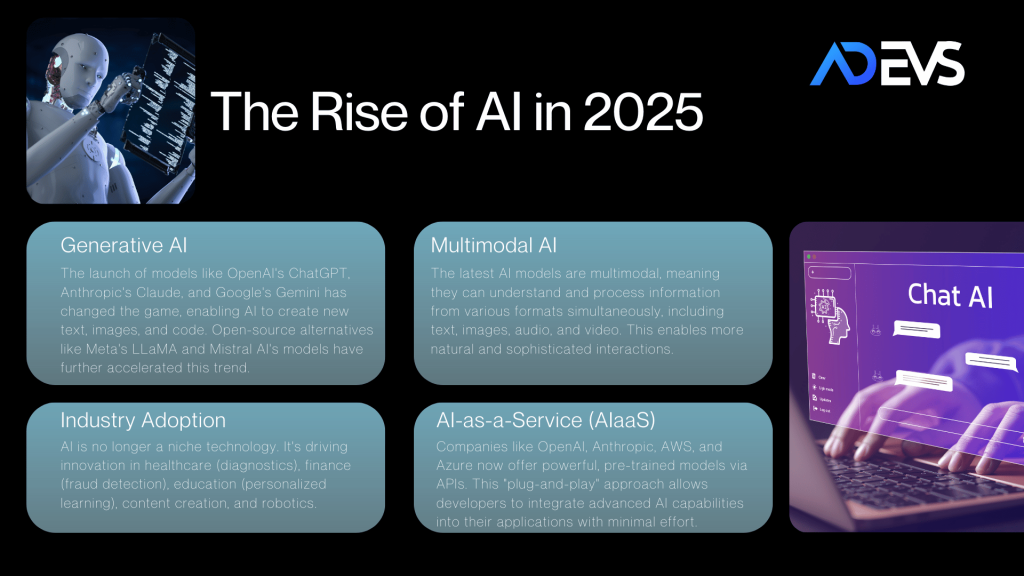
- Generative AI: The launch of models like OpenAI’s ChatGPT, Anthropic’s Claude, and Google’s Gemini has changed the game, enabling AI to create new text, images, and code. Open-source alternatives like Meta’s LLaMA and Mistral AI’s models have further accelerated this trend.
- Multimodal AI: The latest AI models can understand and process information across text, images, audio, and video simultaneously. This multimodal capability enables more natural and sophisticated interactions.
- Predictive AI: Beyond generating content, AI is becoming highly effective at forecasting outcomes — from predicting customer behavior to anticipating supply chain disruptions — giving businesses a proactive advantage.
- Agentic AI: Emerging “agent-like” systems are designed to act autonomously. Instead of waiting for prompts, they can plan tasks, take actions, and learn from results — making them powerful digital collaborators.
- Vertical AI: Specialized AI solutions built for specific industries (like legal tech, healthcare, or retail) are on the rise. Unlike general-purpose AI, vertical AI focuses on solving domain-specific challenges with high precision and reliability.
Key Considerations Before You Create an AI Model
Before diving into the technical details, it’s crucial to lay a solid foundation. Let’s know the key Considerations to Create an AI Model Successfully
Defining the Problem
First and foremost, ask: What specific problem do you want your AI to solve? A clearly defined goal is the most important step. Are you trying to automate customer support, predict sales trends, classify images, or generate marketing copy? A precise problem statement will guide every subsequent decision.
Data Availability and Quality
Data is the lifeblood of any AI model. Do you have access to the necessary data? Is it high-quality, relevant, and sufficient in quantity? Without good data, even the most advanced algorithm will fail.
Pre-trained vs. Custom Models
You face a critical choice:
- Use a pre-trained model: This involves using an existing model (often via an API call) and possibly fine-tuning it with your own data (a process called transfer learning). This is faster and more cost-effective.
- Develop a custom model: Building an AI model from scratch provides maximum control and customization but requires significant expertise, time, and resources.
Budget, Computing Power, and Scalability
Consider your resources. Training a large model from scratch can be expensive, requiring powerful GPUs (Graphics Processing Units) and significant cloud computing credits. Plan for scalability from the beginning. How will your model handle increased demand as your user base grows?
Step 1: Data Collection & Preparation
It’s often said that “data is the new oil,” and in the world of AI, this couldn’t be more true. The performance of your model is fundamentally dependent on the quality of your data.
Data Sources in 2025
Finding datasets is easier than ever. Great resources include:
- Kaggle: A popular platform for data science competitions with a vast repository of datasets.
- Hugging Face Datasets: A massive collection of open-source datasets ready for use with popular ML frameworks.
- Google Dataset Search: A search engine specifically for finding datasets.
- Enterprise APIs: Many companies offer data through APIs, which can be a source for real-time information.
Qualities of Good Data
Your dataset should be:
- Relevant: Directly related to the problem you are solving.
- Diverse and Unbiased: Representative of the real-world scenarios your model will encounter. Biased data leads to biased and unfair models.
- Accurate: Free from errors and correctly labeled (for supervised learning).
Data Preprocessing
Raw data is almost always messy. Preprocessing is the crucial step of cleaning and transforming it into a usable format. This includes:
- Cleaning: Removing duplicates and correcting errors.
- Handling Missing Values: Deciding whether to remove incomplete records or fill in the gaps (a process called imputation).
- Scaling and Normalization: Bringing all numerical features to a similar scale to help the model learn more effectively.
- Encoding: Converting categorical data (like text labels) into a numerical format.
At this stage, it’s vital to consider AI bias and fairness. Scrutinize your data for potential biases related to race, gender, or other demographics to ensure you are building a responsible AI model.
Step 2: Choosing Frameworks & Tools
With your data ready, the next step is to select the right tools for the job.
- Programming Languages: Python remains the undisputed king of AI development due to its simplicity and extensive library support. Languages like Rust and Julia are gaining traction for performance-critical applications, but Python is the standard.
- Frameworks: TensorFlow and PyTorch are the two dominant deep learning frameworks. JAX is a rising star from Google known for its high-performance capabilities. For traditional machine learning, Scikit-learn is an essential library.
- No-Code/Low-Code Platforms: Tools like Runway and Google’s Vertex AI allow you to build AI models with a graphical interface, making AI accessible even without coding expertise.
- Cloud & AIaaS Platforms: AWS SageMaker, Azure Machine Learning, and Google Cloud AI provide end-to-end platforms for building, training, and deploying models at scale. The OpenAI API gives you direct access to models like GPT-4.
Step 3: Understanding AI Algorithms
The algorithm is the engine of your AI model, guiding how it learns from data and improves with experience. Choosing the right algorithm is crucial when you create an AI model, since each is designed to solve a different type of problem. Some are best at classification, others at prediction, pattern recognition, or content generation.
At its core, an algorithm is a set of mathematical rules. During training, it processes data, adjusts weights, and refines its accuracy over time. The right choice depends on your goal, data format, and task complexity. For example, decision trees can handle simple predictions, while transformer networks excel at understanding language.
Types of Machine Learning
- Supervised Learning: The model learns from labeled data. This is used for tasks like classification (e.g., is this email spam or not?) and regression (e.g., what will be the price of this house?).
- Unsupervised Learning: The model finds hidden patterns in unlabeled data. This is used for clustering (e.g., grouping customers by purchasing behavior) and dimensionality reduction (simplifying complex data).
- Reinforcement Learning: The model learns through trial and error, receiving “rewards” or “penalties” for its actions. This is powerful for gaming (AlphaGo), robotics, and automated trading systems.
- Generative AI: A newer class of algorithms focused on creating new content. This includes LLMs for text generation (ChatGPT) and diffusion models for image generation (Stable Diffusion, Midjourney).
Step 4: A Closer Look at Neural Networks
For many modern AI tasks, you’ll be working with neural networks, which are inspired by the structure of the human brain.
- The Basics: A neural network consists of layers of interconnected “neurons.” Data enters through the input layer, is processed in one or more hidden layers, and a result is produced at the output layer.
- CNNs (Convolutional Neural Networks): The go-to architecture for image recognition tasks. They are exceptionally good at detecting features like edges, textures, and shapes.
- RNNs/LSTMs (Recurrent Neural Networks): Designed for sequential data like text or time series. They have a form of “memory” that allows them to consider previous inputs when processing the current one.
- Transformers: This revolutionary architecture is the backbone of modern LLMs like ChatGPT. Its key innovation is the “attention mechanism,” which allows the model to weigh the importance of different words in a sentence, leading to a much deeper understanding of context. In 2025, multimodal transformers that can process text, images, and audio are becoming the new standard.
Step 5: Training Your Model
Training is the process where the model learns from the data. This involves an iterative loop:
- The model makes a prediction (forward pass).
- It compares its prediction to the actual outcome and calculates the error.
- It adjusts its internal parameters to reduce this error (backpropagation).
This process is repeated thousands or even millions of times.
- Hardware: Training deep learning models requires immense computational power. GPUs are standard, but specialized hardware like TPUs (Tensor Processing Units) and other cloud accelerators can speed things up even more.
- Hyperparameter Tuning: These are the settings that you configure before training, such as the learning rate. Finding the optimal hyperparameters is crucial for performance and can be done through methods like grid search or more advanced techniques like Bayesian optimization and AutoML.
- Avoiding Overfitting and Underfitting: Overfitting is when a model learns the training data too well and performs poorly on new, unseen data. Underfitting is when the model is too simple to capture the underlying patterns. Finding the right balance is a key challenge in AI model development.
Step 6: Evaluating & Improving Your Model
How do you know if your model is any good? By evaluating its performance with metrics.
- Common Metrics: For classification, you’ll use accuracy, precision, recall, and F1-score. For regression, you’ll use Mean Absolute Error (MAE) or Root Mean Squared Error (RMSE).
- Evaluation Tools: A confusion matrix helps visualize the performance of a classification model, while an ROC curve shows its diagnostic ability.
- Validation: Cross-validation is a technique where the data is split into multiple parts, and the model is trained and tested on different combinations to ensure it generalizes well.
- Improvement Techniques: If performance isn’t good enough, you can try advanced methods like ensemble learning (combining multiple models), transfer learning (using a pre-trained model as a starting point), or model distillation (training a smaller model to mimic a larger one).
Step 7: Deploying Your AI Model
A model is only useful if people can interact with it. Deployment is the process of making your model available in a production environment.
- Deployment Options: You can host your model in the cloud (AWS, Azure, GCP), on edge devices (like smartphones or IoT sensors), or use a hybrid approach.
- APIs and Integrations: The most common way to expose your model is through an API (Application Programming Interface). REST is a popular standard, but gRPC can be faster for internal services.
- Containerization: Tools like Docker and Kubernetes are essential for packaging your model and its dependencies into a portable container, ensuring it runs consistently anywhere.
Step 8: Maintenance & Continuous Learning
Your work isn’t done after deployment. Models can degrade over time as the real world changes.
- Model Drift: This occurs when the statistical properties of the input data change, causing model performance to decline.
- Monitoring: Tools like MLflow and Weights & Biases help you monitor your model’s performance in production and detect drift.
- Automated Retraining: Setting up a pipeline for continuous integration and continuous delivery (CI/CD) for your ML models ensures they can be automatically retrained on new data to maintain their accuracy.
- Feedback Loops: Collect user feedback to identify areas for improvement.
How to Create an AI Model Responsibly: Ethics in 2025
As AI becomes more powerful, the ethical implications are increasingly significant. Building responsible AI is no longer optional, now it’s essential.
Bias and Fairness: Audit your datasets and models to detect and mitigate biases. Include diverse data and regularly test outputs to ensure fair and equitable outcomes.
Transparency and Explainability (XAI): In critical domains like healthcare, finance, and hiring, ensure models can explain decisions clearly. Explainability builds trust and accountability.
AI Governance: Compliance with emerging regulations is crucial. In 2025, this includes frameworks like the EU AI Act, the U.S. AI Bill of Rights, and ISO/IEC AI standards. These provide guidance on fairness, transparency, and responsible deployment.
Human Oversight: Even as AI becomes autonomous, humans should remain in the loop for high-stakes decisions, ensuring accountability and alignment with ethical standards.
By embedding fairness, transparency, and governance into every stage of development, organizations can deploy AI safely, responsibly, and effectively.
The Future of AI Model Creation
The field of AI is moving at a breakneck pace. We are witnessing the democratization of AI, where anyone with a good idea can build and deploy powerful models. The focus is shifting from “training models” to “orchestrating AI ecosystems,” where multiple specialized models work together. Discussions around Artificial General Intelligence (AGI), AI with human-like cognitive abilities, are moving from science fiction to serious research.
Your Path to Building AI Model
Creating an AI model is a journey that combines science, art, and engineering. While it may seem complex, the tools and resources available in 2025 have made it more accessible than ever. Start small. Experiment with open datasets, try transfer learning with a pre-trained model, and focus on solving a real-world problem.
We understand that even with all this guidance, building an AI solution for your business can feel overwhelming. If you want expert support, schedule a call with one of our AI specialists at ADEVS. We will help you plan, build, and deploy an AI model that is perfectly tailored to your business goals. Your journey to building AI starts here.