
Most founders who have burned through their runway building the wrong thing tell the same story. They had a clear vision, a capable team, and months of development behind them, and then discovered after launch that nobody wanted what they built.
MVP development for startups exists specifically to prevent that outcome. It does this not by building less, but by building smarter: shipping the smallest version of your product that can teach you something real, fast, before you commit six months and 100,000 dollars to a direction you have not yet validated.
This guide is for founders who are past the idea stage but have not yet broken ground on a product. You will get a practical five stage MVP development process for startups in 2026, honest cost and timeline ranges, stack recommendations, and the mistakes that consistently kill early products, along with what to do instead.
What Is MVP Development for Startups?
MVP development for startups is the process of scoping, building, and launching the smallest usable version of a product that can generate real user feedback and validate your assumptions about demand. It is about getting a working product in front of users quickly so you can see what actually works.
“Minimum” does not mean a cheap version of your full product. It means the simplest thing that can answer the key question your business depends on, usually whether people will:
- Pay for it
- Use it regularly
- Recommend it to others
Tip: If a feature does not help you answer one of those three questions, it probably does not belong in your MVP.
ADEVS Team
The idea comes from the Lean Startup build, measure, learn loop. You build something, measure how users respond, and learn whether your assumptions were right, then you iterate or pivot based on that learning.
What an MVP Is Not:
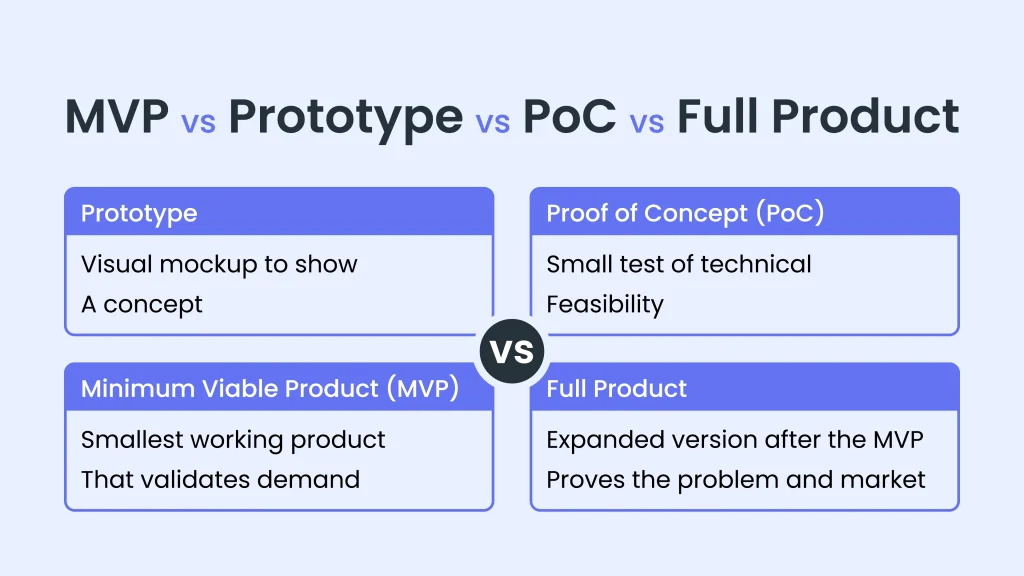
An MVP is not a prototype, a proof of concept, or a full product:
- Prototype
A visual or interactive mockup used to show a concept, usually without a real backend. - Proof of concept (PoC)
A small experiment that tests whether something is technically possible. - Full product
The more complete version you build after your MVP has proven you are solving the right problem for the right people.
Confusing these is where scope creep and budget drift usually start.
When Is a Startup Ready for MVP Development?
Building an MVP before you are ready does not save time. It creates a product that answers the wrong question, or no question at all.
Before you start development, you should be able to check all of these:
- You can describe the problem your product solves in one sentence, without using the word “platform”
- You have spoken directly to at least 10 people who experience that problem and are actively trying to solve it
- You have identified a specific, narrow user segment, not “everyone who does X”
- You have some early signal of demand, such as a waitlist, pre orders, letters of intent, or people who have already paid you something
- You have a clear definition of what “this MVP is working” means, expressed in a metric you can measure
Tip: If you cannot clearly define who you are building for, what problem you solve, and how you will judge success, you are not ready to start MVP development yet.
ADEVS Team
You are probably too early for MVP development if:
- Your target user is “anyone who needs X” or “businesses of all sizes”
- You have not talked to potential users yet and plan to do that only after you build something
- The main reason you want to build is that you think the idea is good, not that users have told you they need it
- You have no budget clarity and hope the MVP will be cheap enough to figure out later
None of these mean your idea is bad. They mean the highest value activity right now is customer discovery, not development.
MVP Development for Startups in 5 Clear Stages
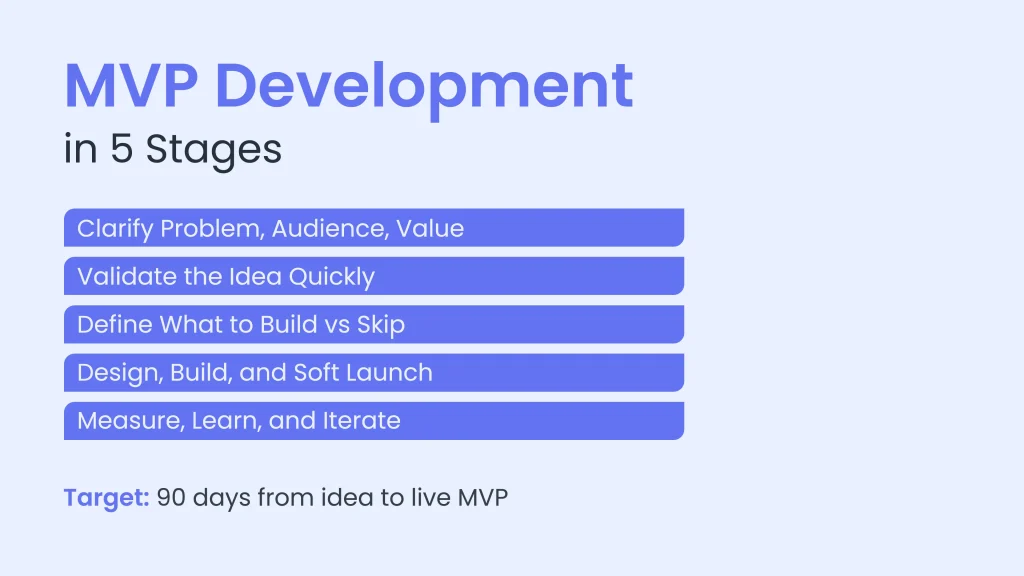
Stage 1: Clarify the Problem, Audience, and Value Proposition
Before any design or development work starts, you need three things written down and agreed:
- A problem statement that describes what your target user is struggling with, how often it happens, and what they currently do about it. Vague problem statements produce vague products.
- A user persona that captures who your early adopter is, including their role, context, technical comfort, and what they care about most. You are not building for the average user, you are building for the person most likely to try something new and give you honest feedback.
- A value proposition that states what your product does, for whom, and why that is better than what they do today. If you cannot write this in two sentences, your scope is not clear enough to build from.
This stage usually takes one to two weeks and should not involve any design software or code.
Stage 2: Validate the Idea Quickly
Validation happens before the build, not after. The goal is to stress test your assumptions using the cheapest possible methods. At minimum this means:
- Competitor research: who else is solving this problem, how they do it, and what gaps their users complain about in reviews
- Direct interviews with 5 to 10 people who fit your persona, focused on what they do today rather than their opinions about your future product
- A simple landing page or waitlist that describes your product and measures whether people are willing to give you their email or pre purchase access
A landing page that converts at 15 to 30 percent from targeted traffic is a meaningful signal. One that converts at 2 percent despite repeated copy changes is telling you something important before you spend money on development.
Stage 3: Define What to Build vs What to Skip
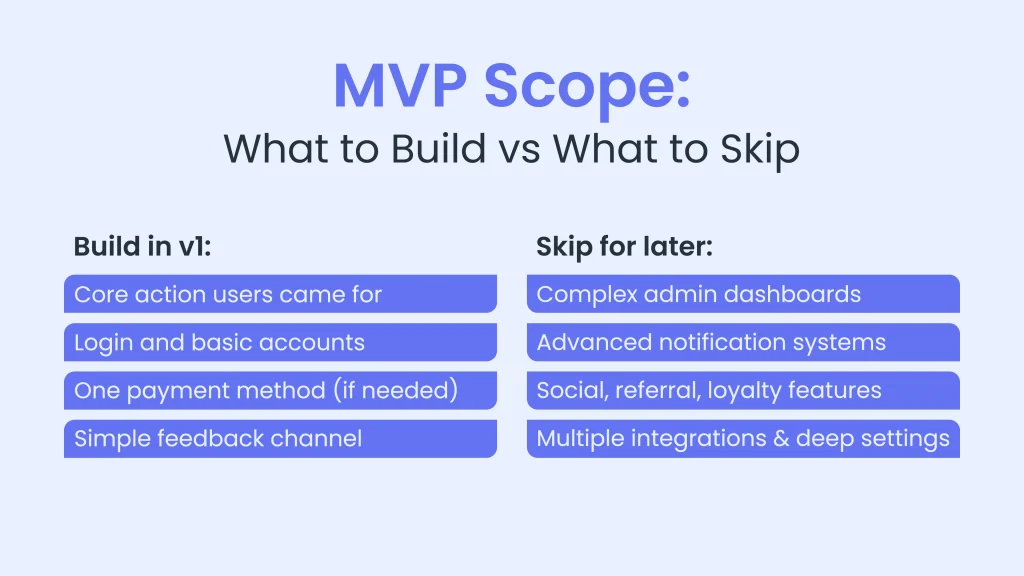
This is where most MVPs go wrong. The natural instinct is to list every feature the product needs to be good and then build all of them. The disciplined approach is to ask what is the single workflow that delivers the core value, and what is the absolute minimum required to make that workflow functional.
A useful exercise is to write every feature on a separate card or line, then remove anything that a user could work around manually in the first 30 days. If a user can send you an email instead of using an in app notification, the notification is not MVP scope. If they can export a CSV instead of having a reporting dashboard, reporting is not MVP scope.
What typically belongs in an MVP:
- The core action your product enables (the thing users came for)
- User authentication (login, basic account management)
- One payment method if your business model requires it
- Enough feedback surface to learn from, even just a simple survey or contact form
What typically does not belong:
- Admin dashboards and analytics beyond the basics
- Notification systems more complex than email
- Social features, referral programs, loyalty mechanics
- Multiple integrations with third party tools
- Extensive settings and customization options
The discipline here matters more than the technical choices you make in the next stage.
Stage 4: Design, Build, and Launch Your MVP
Once scope is locked, development can begin. The build phase has three parts.
- Design: Lean UX for an MVP is not about beautiful interfaces, it is about clear ones. Users should not be confused about what to do next. A handful of high fidelity screens for the core workflow is enough. Design the happy path first, edge cases come later.
- Development: Build in short cycles, review working software frequently, and resist scope additions during development. Every “while we are at it” feature request represents unplanned cost and timeline risk. Log them for phase two.
- Launch: A soft launch to a small group of real users, ideally the people you interviewed in stage two, is almost always more useful than a big public launch. You learn more from 20 engaged users than from 500 who bounce after one session. Structure your beta so you can actually talk to the people using it.
The full custom software development process involves more detail than a single section can hold, particularly around the design to development handoff and how to structure your QA process before launch.
Stage 5: Measure, Learn, and Iterate
Shipping is not the end of MVP development, it is the beginning of the learning phase the whole process was designed to reach.
Define your success metrics before launch, not after. Decide what “this MVP is working” means in one or two numbers, then use them to guide your decisions after release.
At a minimum, you should track whether users complete the core action, whether they come back, and what they tell you in conversations, support tickets, and surveys. If activation is low, the problem is usually onboarding or value clarity. If retention is low after strong activation, the product is solving a one time need rather than a recurring one.
You can go deeper into specific benchmarks and signals in the later section on metrics that show if your MVP is working.
Types of MVPs and Which One Fits Your Startup
Not every MVP requires months of custom development. The right format depends on what assumption you are trying to test and how quickly you need to test it.
No‑Code or Low‑Code MVP
Tools like Bubble, Webflow, Glide, and Notion let non‑technical founders build functional products without writing code. A no‑code MVP typically takes 4 to 8 weeks and costs 5,000 to 20,000 dollars if you are working with someone who specializes in these platforms.
Best suited for: idea validation at pre seed stage, non‑technical founders who need to demonstrate traction before raising money, and use cases where the core workflow is not technically complex.
The trade off is scalability. No‑code tools impose architectural constraints that become expensive to work around when you need performance at scale or custom integrations with enterprise systems.
Concierge or Manual Operations MVP
A concierge MVP looks automated to the user but is powered by human labor behind the scenes. The user places an order, an algorithm appears to process it, but a human is actually doing the work manually.
This is one of the fastest and cheapest ways to validate whether users want the outcome your product would eventually automate. It requires almost no development and can be running within days.
Best suited for: marketplace ideas, service heavy products, and any use case where you need to understand the workflow before you can design it properly.
The limit is obvious. It does not scale, and users eventually notice. The goal is learning, not operating.
Clickable Prototype or Design Only MVP
A high fidelity prototype built in Figma or similar tools can simulate a real product well enough to gather meaningful feedback from users who are willing to engage with it. It costs less than development and can be built in 2 to 4 weeks.
Best suited for: products where the primary value is in the interface and user experience rather than in data processing or backend logic, and for testing with enterprise buyers who need to see something before agreeing to a pilot.
Custom Built Web, Mobile, or AI MVP
When your value proposition depends on functionality that no‑code tools cannot deliver, such as real time data processing, machine learning, complex integrations, or performance at meaningful scale, custom development is the right choice.
This is the most expensive and time consuming option, but it is also the one that produces a product you can actually build a business on. Cost and timeline ranges are covered in the next section.
How Much Does MVP Development Cost in 2026?
How much does MVP development cost for a startup? The honest answer is that it depends heavily on what you are building, who is building it, and where your team is located.
Here are realistic ranges for 2026:
| MVP Type | Typical Cost Range | Typical Timeline | Best Suited For |
| No‑code / low‑code MVP | 5,000–20,000 USD | 4–8 weeks | Idea validation, pre‑seed stage |
| Concierge / manual MVP | 2,000–10,000 USD | 1–3 weeks | Service products, marketplaces |
| Clickable prototype | 3,000–15,000 USD | 2–4 weeks | UX‑driven products, enterprise pilots |
| Basic custom MVP | 15,000–40,000 USD | 6–10 weeks | Simple SaaS, mobile utility apps |
| Mid‑level custom MVP | 40,000–80,000 USD | 10–16 weeks | B2B SaaS, two‑sided marketplaces |
| Complex / AI MVP | 80,000–150,000+ USD | 16–28+ weeks | Fintech, AI‑heavy products, regulated sectors |
The factors that move cost up or down most:
- Scope: Every feature you add is a multiplier, not an addition. Adding a feature to an MVP does not just add two weeks, it adds those weeks plus design, QA, edge case handling, and future maintenance.
- Team model: An in‑house team in the US can cost 100 to 150 dollars per hour for senior developers. Eastern European agencies often run 40 to 70. South Asian teams often run 20 to 50. The same scope can cost three times as much depending on where it is built.
- Tech complexity: A standard CRUD web application costs far less than one that requires real time collaboration, ML inference, or complex third party integrations.
For a line by line breakdown of what drives each cost component, and how to build a budget that accounts for the things agencies often leave out of their estimates, the MVP development budget guide covers this in detail.
Choosing the Right Tech Stack for Your MVP
Stack choice affects timeline as much as scope does. The wrong stack for your situation adds weeks and sometimes months.
Web SaaS MVPs
The most common stack for web based SaaS in 2026 is React or Next.js on the frontend, Node.js or Laravel on the backend, and PostgreSQL as the primary database. This combination has a large talent pool, extensive tooling, and a long track record in production.
If your team is already comfortable with Laravel or Django, use what you know. Stack novelty during an MVP adds friction for no benefit.
Mobile MVPs
For most mobile MVPs, building separate native iOS and Android apps is not justified by the extra development cost. React Native and Flutter both produce cross‑platform apps from a single codebase and have matured significantly. The performance and cost trade-offs between React Native and Flutter are worth understanding before you commit, particularly if your app has complex animations or hardware integrations.
AI‑Enabled MVPs
AI MVPs typically combine a React or Next.js frontend with a Python backend such as FastAPI, a vector database for retrieval augmented generation use cases, and an LLM API rather than a self hosted model. The cost of training custom models at MVP stage is almost never justified. Fine tune or prompt engineer a hosted model first.
When to Use No‑Code vs Custom Development
Use no‑code if you are pre‑funding, your core workflow has no unusual technical requirements, and speed to first user matters more than scalability.
Use custom development if your competitive advantage is in the technical execution, you have paying customers who need reliability and performance, or you are raising a round where investors will inspect the architecture.
The most expensive mistake is building with no‑code tools and then rewriting everything from scratch six months later because the platform cannot support your growth. If you can see that path clearly from the start, build custom from day one even if it takes longer.
Common MVP Mistakes Startups Make (And How to Avoid Them)
Building too many features at v1. Every feature you add increases scope, extends the timeline, raises cost, and adds more room for bugs.
Do this instead: lock your feature list before development starts and treat any new ideas during the build as phase two.
No clear success metric before launch. If you do not know what “this worked” means, you cannot tell whether to iterate or kill the product.
Do this instead: choose one primary success metric before you write code, usually activation rate or week two retention.
Ignoring user feedback. Treating feedback as noise instead of signal is how you miss product market fit.
Do this instead: talk to a few active users every week and feed what you learn directly into your roadmap.
Over engineering the architecture. Microservices for a product with 50 users waste months and budget that should go into learning and acquisition.
Do this instead: start with a simple, well structured monolith and split it only when complexity justifies it.
No distribution plan. Many founders spend months on product and almost no time on how they will get their first hundred users.
Do this instead: define how you will reach your first ten users before you build. Write down who they are and how you will reach them.
Integrating Marketing and SEO Into MVP Development
Most technical MVP guides stop at shipping. The best time to build your early marketing foundation is while your product is in development, not after launch.
Set Up Analytics and Feedback Before You Launch
Install analytics before your first user arrives. At minimum, set up Google Analytics 4, Google Search Console, and a session recording tool.
Add a simple in product survey after users complete the core action.
Questions like “What almost stopped you from signing up?” will shape your roadmap more than any dashboard at this stage.
Plan a Small SEO Footprint Around Your Use Case
You do not need a full content strategy. You need 3 to 5 focused landing pages that describe your product in the language your users search for, plus a few long tail articles that answer their key questions.
Pick 8 to 12 keywords where intent matches your value and you can realistically rank within a few months. Publish early so pages have time to index before you need traffic.
Content MVP: Test Your Message Before You Scale
Treat content like an MVP. Publish one piece that solves one problem well, see if it drives signups or demos, and only then invest in more.
Teams that grow fastest usually master one distribution channel deeply before spreading effort across many.
Metrics That Show If Your MVP Is Working
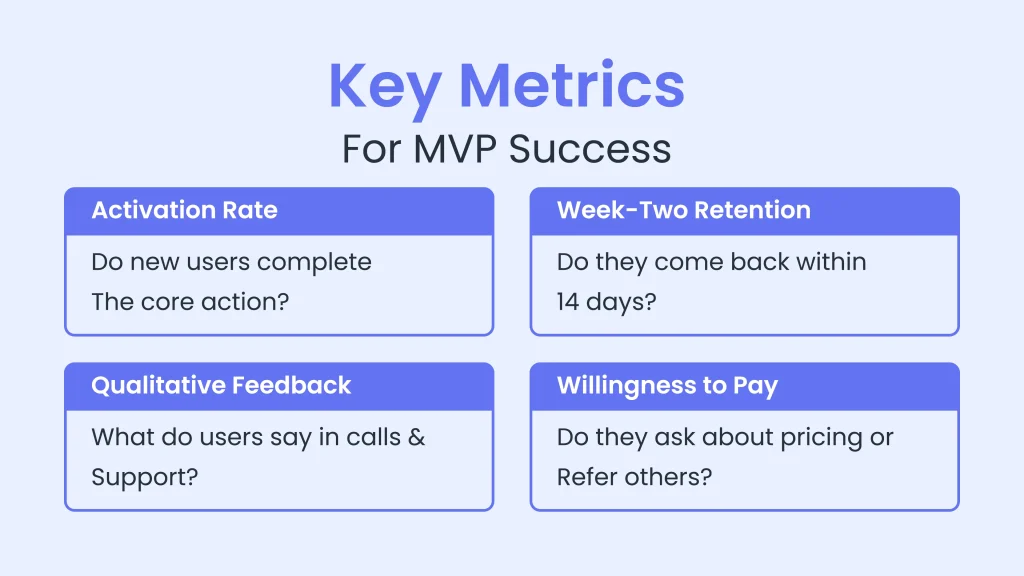
What counts as “working” depends on your business model, but a few signals matter for almost every MVP.
Activation rate is the percentage of new users who complete the core action at least once. If activation is below about 40 percent, onboarding or value clarity is usually the problem. Above 60 to 70 percent for a web app is a strong signal.
Week two retention is often the single most important metric for recurring use products. If users activate but do not return within 14 days, your product is probably solving a one time problem rather than a recurring one.
Qualitative signal is what users tell you in calls, support tickets, and surveys. The language they use to describe their problem is often exactly what your marketing copy should say.
For pre revenue MVPs, willingness to pay can be proxied by whether users complete a checkout flow, ask about pricing unprompted, or refer others before you have a referral program. Any of these is a meaningful signal.
A rough rule of thumb: if week two retention is above 20 to 25 percent and you see organic referrals, you have something worth doubling down on. If activation is below 20 percent despite product improvements, you may have a positioning problem rather than a product problem.
Real‑World MVP Patterns
Understanding what early versions of products actually looked like, not the polished retrospective version, helps calibrate what “minimum” really means in practice.
B2B SaaS dashboard
A common pattern is an MVP with three screens (login, main dashboard, settings), one core workflow fully functional, and everything else hidden or replaced by a support email. It ships in about 10 to 12 weeks. The main lesson is that users repeat the workflow they came for and mostly ignore configuration options.
Two‑sided marketplace
Version one is almost always supply side only with manual matching. The founder recruits supply manually, matches them to demand manually, and only builds the matching algorithm once the pattern is clear. Trying to build both sides and the algorithm at once is how marketplace MVPs run out of money.
Mobile utility app
The MVP ships two things: the one feature users came for and a way to share results. Most of the other planned features are cut. Founders often discover that sharing drives more retention than extra in app functionality.
AI assistant for a workflow
v1 automates one specific task in one specific context, with a human fallback for everything else. The model is a well crafted system prompt hitting a single API endpoint, not a fine tuned model on complex infrastructure. Complexity is added only after the core use case is validated and users are asking for more.
How ADEVS Helps Startups Build MVPs Faster
At Adevs, we have shipped MVPs across SaaS, mobile, marketplace, and AI products for founders from pre seed through Series A as part of our custom software solutions for startups. The projects that go well follow a simple structure.
We start with a one to two week discovery phase to clarify scope, validate your priorities, and identify which architectural risks are worth solving early. Most founders arrive with a feature list. We help translate that into a build plan with a realistic timeline and a clear definition of done.
Development then runs in short sprints, with working software reviewed at the end of each cycle. You see the product itself evolve, not just a status report. After launch, we support measurement and iteration, because the first version rarely finds product market fit on its own.
If you are ready to move from idea to build, talk to our team about your MVP. We will be honest about what we think the right scope is, what it will cost, and how long it will take.
FAQs –
What is MVP development for startups?
MVP development for startups is the process of building the smallest functional version of a product that can generate real feedback from real users. The goal is to learn quickly whether your core assumptions about demand are correct before committing to full product development.
How much does MVP development cost for a startup in 2026?
Costs range from about 5,000 dollars for a simple no code MVP to 150,000 dollars or more for a complex AI enabled product. Most custom MVPs for B2B SaaS or mobile apps fall in the 25,000 to 80,000 dollar range, depending on scope, team location, and technical complexity.
How long does MVP development take?
Simple no code MVPs can be ready in 4 to 8 weeks. Custom built MVPs usually take 10 to 20 weeks, and AI heavy or heavily integrated products can take 6 months or longer, with feature scope being the main driver of timeline.
Should a startup use no code or custom development for an MVP?
Use no code if you are validating an idea at pre seed stage and your core workflow does not need custom logic. Use custom development if your edge is technical execution, you already have paying customers, or you know no code tools will not scale to your requirements.
What are the stages of MVP development for a startup?
The five stages are: clarify problem, audience, and value proposition; validate your idea through research and interviews; define what to build versus what to skip; design, build, and soft launch; measure user behavior, collect feedback, and iterate or pivot.
What is the difference between an MVP and a prototype?
A prototype is a visual mockup used to demonstrate a concept and has no real functionality. An MVP is a working product that real users can interact with and that produces real behavioral data.
What metrics should I track for my MVP?
The most important metrics are activation rate, week two retention, and qualitative feedback. For pre revenue MVPs, willingness to pay, such as users completing a checkout or asking about pricing, is the clearest signal of real demand.
Conclusion
MVP development for startups is not about building less, it is about building the right thing first and having the discipline to leave everything else for later. The startups that reach product market fit fastest define a narrow problem, validate it before they build, and ship the smallest functional version that tests their core assumption.
The ones that stall usually either wait too long to ship or release something so broad that they learn nothing specific before runway runs out. Treat the 90 day framework in this guide as a constraint that forces prioritization and keeps you focused on learning over perfection.If you are at the point where the idea is clear and the next step is deciding exactly what to build, start that conversation with our team.