
US businesses spent over $110 billion on AI software in 2025, yet most small business owners still don’t know what AI agent integration actually costs them. The subscription price tag on an AI tool is only the beginning. Hidden integration, maintenance, and retraining costs can triple your real spend before you see a single dollar of return. This post breaks down the true AI agent integration cost for small business in 2026, including every line item vendors don’t put in their sales decks. You’ll walk away knowing exactly what to budget, what to avoid, and whether off-the-shelf AI agents or custom integration makes more sense for your business.
Why AI Agent Integration Cost for Small Business Is Suddenly Exploding
OpenAI, Google, and Microsoft all expanded their autonomous AI agent platforms in Q1 and Q2 2026. That triggered a massive wave of US SMB interest in AI workflow automation for SMBs across retail, professional services, healthcare, and logistics. According to Gartner’s Agentic AI research, 33% of enterprise software applications will include agentic AI by 2028, up from less than 1% in 2024. However, enterprise numbers don’t tell the full SMB story.
Small businesses face a different challenge. They don’t have dedicated IT departments to install and configure agentic AI tools 2026 vendors are pushing. Furthermore, most AI agent products are designed for large organizations with clean data pipelines and standardized software stacks. If your business runs on a mix of QuickBooks, a legacy CRM, and a couple of spreadsheets, integrating an AI agent into that environment requires serious custom work, and serious budget.
What Are AI Agents, and Why Do They Cost More Than SaaS Tools?
AI agents are software programs that can plan, decide, and execute multi-step tasks on their own. In contrast, traditional SaaS automation tools like Zapier or Make run fixed, rule-based workflows you program manually. AI agents can adapt. They can handle exceptions, loop back, and make judgment calls. That flexibility is exactly what makes them powerful, and exactly what makes integration expensive.
AI Agents vs SaaS Tools: The Core Difference
Think about the difference between a thermostat and an HVAC technician. A SaaS automation tool is the thermostat. It turns on when you set it. An AI agent is the technician. It diagnoses the problem, adjusts multiple systems, and reports back. Because of this, the agent needs access to multiple data sources, clear instructions, error-handling logic, and a way to communicate results. All of that requires integration work that no SaaS subscription covers.
| Feature | SaaS Automation Tools | AI Agents (Agentic AI) |
|---|---|---|
| Decision-making | Rule-based only | Adaptive, context-aware |
| Setup complexity | Low to medium | High without custom integration |
| Monthly SaaS cost | $50 to $500/month | $200 to $2,000+/month |
| Integration cost | $0 to $5,000 | $8,000 to $75,000+ |
| Ongoing maintenance | Minimal | Monthly tuning required |
| Custom workflow fit | Partial | Full (with custom build) |
How Much Does AI Automation Cost at the SaaS Level?
If you’re asking how much does AI automation cost at the subscription tier, the answer ranges from $200 to $2,000 per month for popular agentic AI tools 2026 vendors are selling. Microsoft Copilot for Business runs $30 per user per month. Salesforce Agentforce starts at $2 per conversation. Tools like Relevance AI or Bardeen AI charge usage-based fees that scale quickly with volume. That said, none of those prices include what it actually takes to make the agent work inside your specific business environment.
The Real AI Agent Integration Cost for Small Business: A Full Breakdown
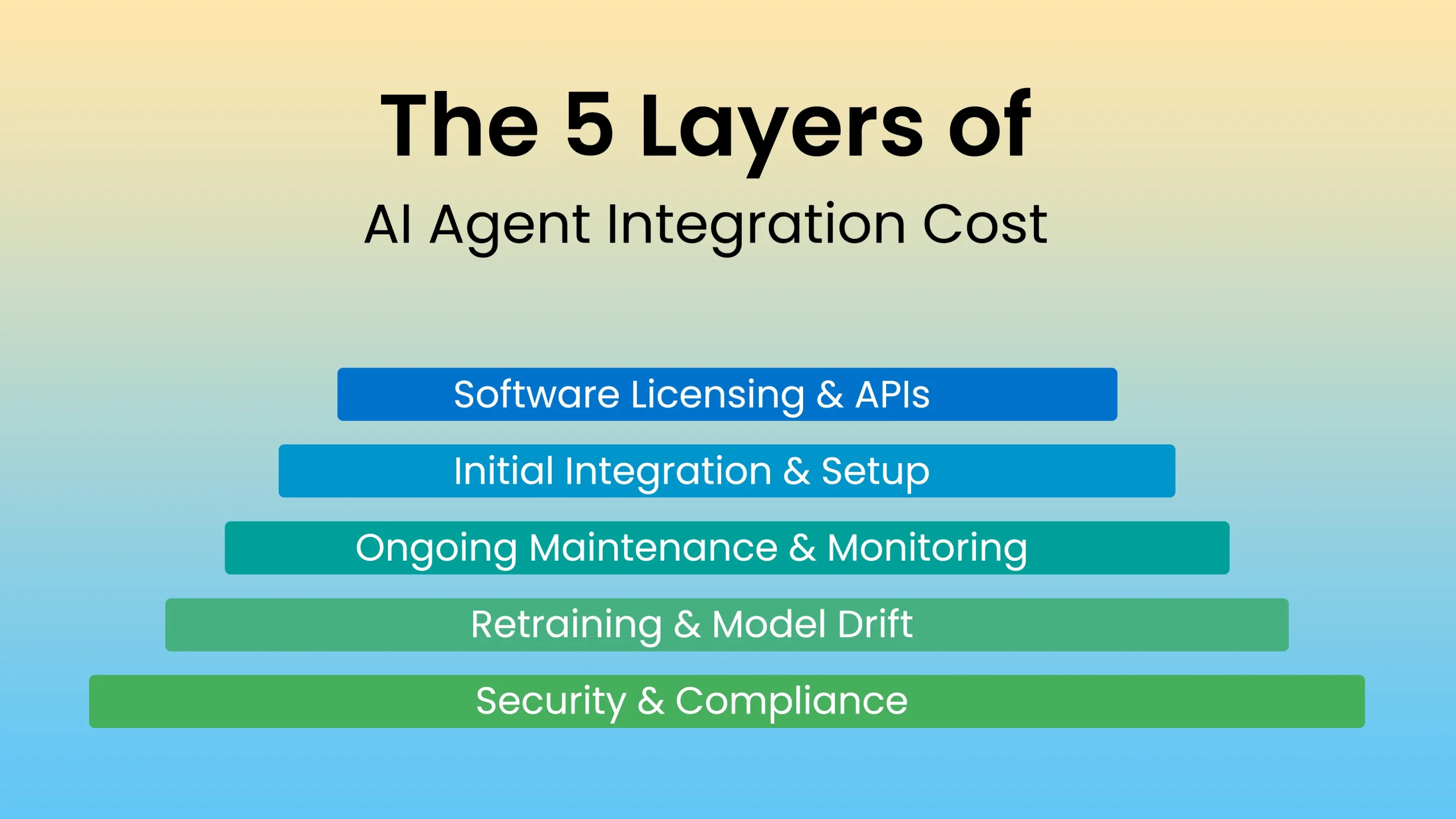
Most vendors show you one number. The real total-cost-of-ownership has five separate layers. Each one adds to the bill. Understanding all five is the only way to budget accurately for AI workflow automation for SMBs.
Layer 1: Software Licensing and API Costs
- SaaS platform fees: $200 to $2,000 per month depending on users and features
- LLM API usage (OpenAI, Anthropic, Google Gemini): $0.002 to $0.06 per 1,000 tokens, which adds up fast at scale
- Third-party connector tools (Make, n8n, custom APIs): $50 to $500 per month
Layer 2: Initial Integration and Setup Costs
- Discovery and scoping: $1,500 to $5,000
- API development to connect AI agent to your CRM, ERP, or POS: $5,000 to $30,000
- Data cleaning and formatting for agent compatibility: $2,000 to $15,000
- Testing and quality assurance: $1,500 to $8,000
- Staff training and documentation: $1,000 to $4,000
Layer 3: Ongoing Maintenance and Monitoring
AI agents aren’t “set it and forget it.” They need regular prompt tuning, model updates, and performance monitoring. Software maintenance costs for AI-integrated systems typically run 15% to 25% of your initial build cost per year. For a $25,000 integration, that means $3,750 to $6,250 in annual upkeep. Additionally, every time a connected software platform updates its API, someone needs to fix the integration. That cost is almost never discussed upfront.
Layer 4: Retraining and Model Drift Correction
AI models degrade over time when real-world data changes. This is called model drift. For example, a customer service AI agent trained on your 2024 product catalog will give wrong answers after a 2026 catalog update. Retraining costs range from $2,000 to $20,000 depending on complexity. In practice, most SMBs don’t budget for this at all, and then wonder why their AI agent starts underperforming six months after launch.
Layer 5: Security and Compliance Overhead
AI agents often handle sensitive customer or financial data. Beyond that, they connect to multiple internal systems, creating new attack surfaces. Healthcare SMBs must consider HIPAA compliance. Retail and e-commerce businesses face PCI-DSS implications. Security audits and compliance work can add $3,000 to $15,000 to your initial project cost. To be clear, skipping this layer is not an option if you operate in a regulated industry.
AI Agent Integration Cost for Small Business: Realistic Budget Scenarios
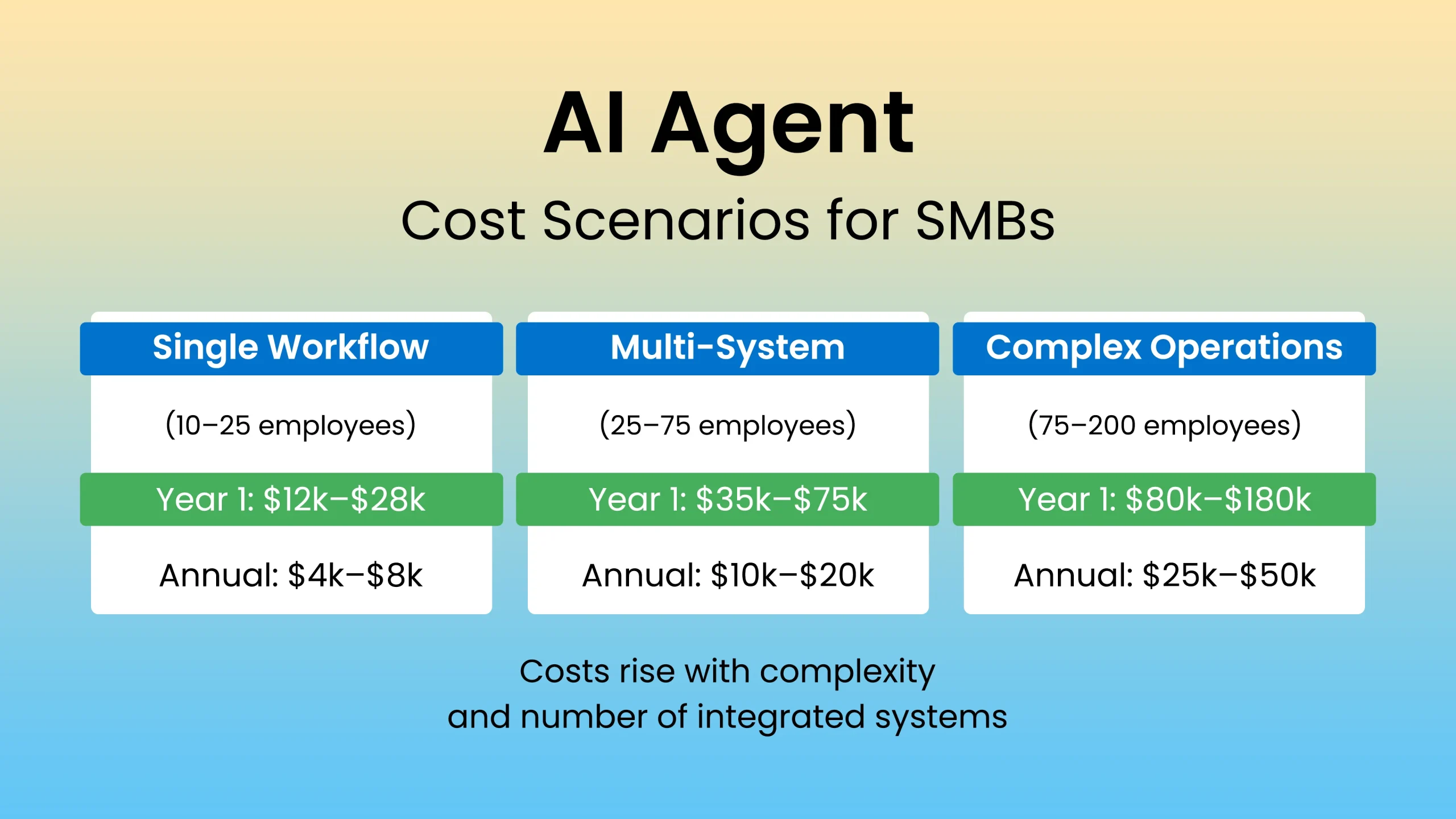
Here are three real-world budget scenarios based on business size and complexity. These numbers reflect what US SMBs actually pay in 2026 for AI workflow automation, not what vendors advertise on their pricing pages.
| Business Profile | Use Case | Year 1 Total Cost | Recurring Annual Cost |
|---|---|---|---|
| 10 to 25 employees, single workflow | AI email triage and response drafting | $12,000 to $28,000 | $4,000 to $8,000 |
| 25 to 75 employees, multi-system integration | AI agent for sales pipeline and CRM updates | $35,000 to $75,000 | $10,000 to $20,000 |
| 75 to 200 employees, complex operations | Multi-agent system for logistics or scheduling | $80,000 to $180,000 | $25,000 to $50,000 |
These figures include all five cost layers described above. Furthermore, they assume you work with an experienced development partner who scopes the project accurately upfront. Going with a freelancer or a vendor-provided “setup wizard” typically increases Year 1 costs by 40% to 60% due to rework and missed requirements.
Custom AI Integration ROI: What the Data Actually Shows
The cost picture only tells half the story. Custom AI integration ROI is the other half, and the numbers are genuinely compelling for businesses that plan well.According to McKinsey’s 2025 AI research, SMBs that deploy AI automation in core workflows see 20% to 30% productivity improvements within 12 months. Meanwhile, businesses that deploy AI tools without proper integration see far lower gains, often under 8%.
“The gap between AI adoption and AI value creation comes down to integration quality. Organizations that connect AI agents to their real workflows consistently outperform those that deploy standalone tools by a factor of three to one.”
McKinsey Global Institute, 2025 AI Productivity Report
Adevs Tech Team
For a 30-person professional services firm billing $3 million annually, a 20% productivity gain translates to roughly $600,000 in additional capacity per year. Even at a $60,000 integration cost, that’s a 10x return in Year 1. Consequently, the SMBs winning with AI in 2026 aren’t the ones who spent the least. They’re the ones who invested in integration that actually fits their operations.
Where Custom AI Integration ROI Is Highest by Industry
- Professional services (law, accounting, consulting): Document drafting, research, and client communication automation. ROI typically 8x to 15x in Year 1.
- Retail and e-commerce: Inventory management, customer service agents, and personalized email campaigns. ROI typically 4x to 9x in Year 1.
- Healthcare practices: Appointment scheduling, insurance pre-authorization, and patient follow-up. ROI typically 5x to 12x in Year 1.
- Logistics and freight: Route optimization, carrier communication, and invoice reconciliation. ROI typically 6x to 14x in Year 1.
The Hidden Costs Vendors Never Tell You About
Most AI agent cost guides only show SaaS subscription prices. This section covers what vendors leave out. Understanding these hidden costs is critical before you sign any contract or kick off any AI workflow automation project for your SMB.
Data Preparation Costs
AI agents need clean, structured data to work properly. Most small businesses have years of messy, inconsistent records scattered across multiple systems. Getting that data into a format an AI agent can use requires a data audit, cleaning, and sometimes a full migration. Forbes reports that data preparation and cleaning can consume around 60% to 80% of a data project’s time. That translates directly to labor costs most vendors never mention.
Change Management and Staff Resistance
Your team has to actually use the AI agent for it to deliver ROI. However, staff resistance is one of the most common reasons AI projects underperform. Training, workflow documentation, and change management support can add $2,000 to $10,000 to a project. In practice, skipping this step costs far more in lost productivity and staff frustration.
Vendor Lock-In and Switching Costs
Many AI agent platforms store your configurations, prompts, and fine-tuned models on their proprietary infrastructure. If you decide to switch vendors, you often can’t export that work. Harvard Business Review and other analysts note that vendor lock-in can significantly increase long‑term technology costs due to higher switching costs and reduced flexibility. With that in mind, any AI integration you build should store core logic in systems you control.
Real-World Case Study: How a Brooklyn Logistics Company Cut Costs with Custom AI Integration
Here’s how AI agent integration played out for a real US business. A 45-person freight brokerage in Brooklyn, New York was spending $18,000 per month on manual load matching, carrier outreach, and invoice processing. Their operations manager estimated staff spent 60% of their day on repetitive data entry and email follow-up.
Before: The Problem
- 3 full-time staff dedicated entirely to carrier communication and invoice matching
- Average 4-hour turnaround on load confirmations
- 12% invoice error rate requiring manual correction
- No visibility into carrier performance trends
After: Custom AI Agent Integration
The company worked with a custom development team to build an AI agent that integrated with their TMS (transportation management system), email platform, and QuickBooks. Total Year 1 cost was $68,000, including integration, data migration, testing, and the first year of ongoing AI software maintenance and support. Results after six months were significant.
- Load confirmation turnaround dropped from 4 hours to under 20 minutes
- Invoice error rate fell from 12% to under 1.5%
- Two of the three dedicated staff moved to higher-value roles
- Monthly operational cost savings: $11,200
- Full payback period: 6.1 months
This outcome wasn’t possible with an off-the-shelf AI agent. Their TMS didn’t have a native integration with any major AI platform. Furthermore, their carrier database required custom logic that no generic tool could handle. Custom AI integration ROI was only achievable because the solution was built around their actual workflow.
AI Agents vs SaaS Tools: Which One Should Your SMB Buy?
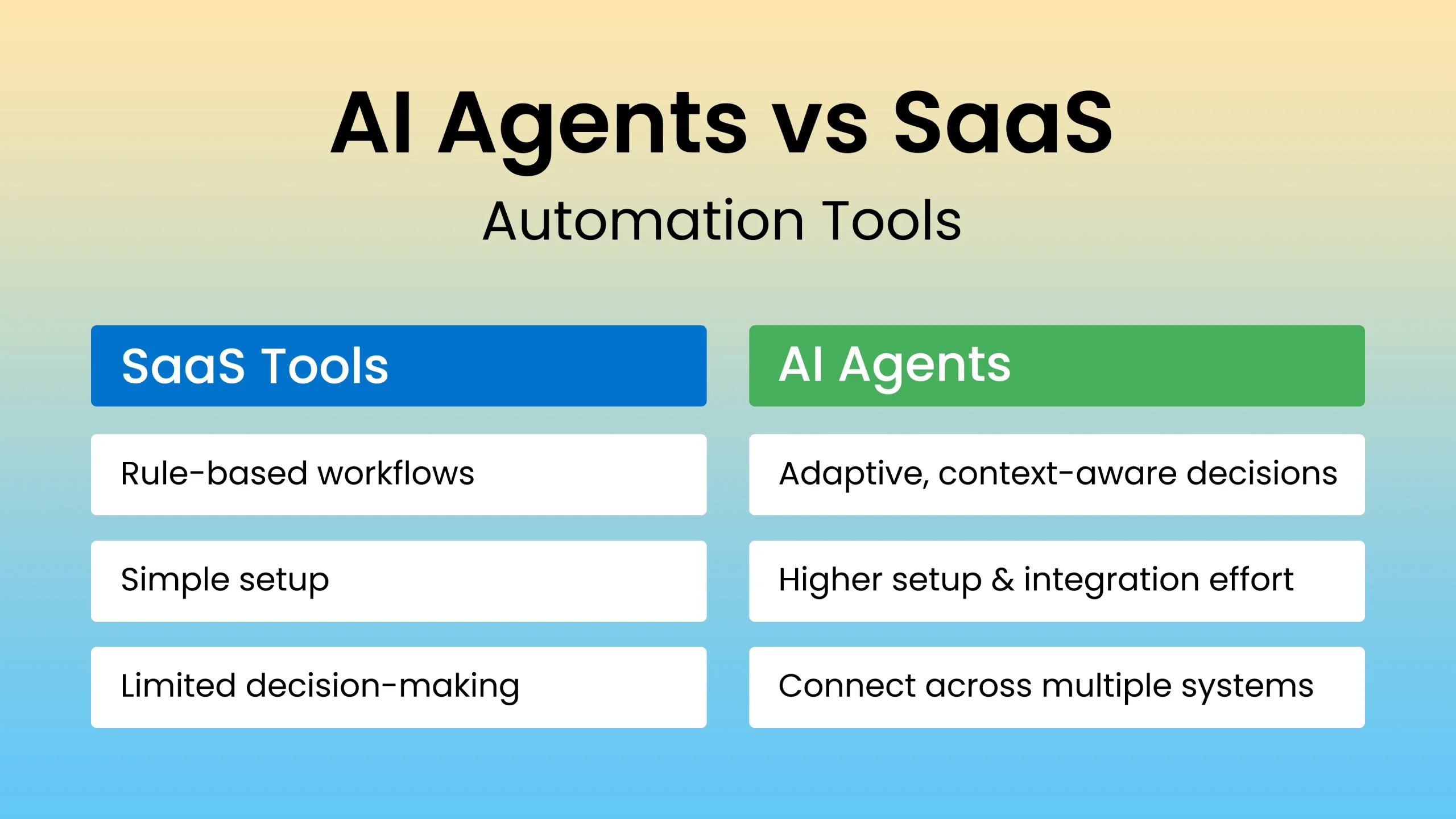
This is the most common question small business owners ask when evaluating agentic AI tools 2026 vendors are pitching hard. The honest answer is that it depends on three factors: workflow complexity, data environment, and budget for the full total cost of ownership.
Choose a SaaS AI Tool If:
- Your workflow is simple and doesn’t cross multiple software systems
- You’re running a pilot and want to test AI value before committing to a full build
- Your team has technical staff who can manage configurations internally
- Your budget for Year 1 is under $15,000 all-in
Choose Custom AI Integration If:
- Your workflow touches two or more software platforms that don’t share a native integration
- Your data is proprietary, regulated, or industry-specific
- You need the agent to make decisions based on your business rules, not generic logic
- You’re serious about ROI and need measurable, auditable outcomes
Most SMBs with 25 or more employees land in the custom integration category. That’s where working with an experienced partner for custom AI integration for your business pays off. Off-the-shelf tools cover about 30% to 50% of what a real business workflow requires. The remaining 50% to 70% is where productivity gains actually live, and where custom integration does its work.
Industry research shows that businesses using custom‑integrated AI solutions report significantly higher satisfaction than those relying on pre‑built AI agents without modification. Additionally, custom integrations tend to deliver higher task completion accuracy in real‑world workflows because they are tailored to the organization’s specific processes and data. This explains why SMBs who invest in proper integration consistently outperform those who buy subscriptions and hope for the best.
How to Evaluate AI Agent Vendors Without Getting Burned
If you’re shopping for AI agent solutions in 2026, you need a clear evaluation framework. Vendors will show you demos that look amazing. However, demos always use clean sample data and pre-configured workflows. Your environment will look nothing like the demo.
Five Questions Every SMB Should Ask Before Signing
- What is the full integration cost, not just the license fee? Ask for a written scope of work that includes API development, data prep, and testing.
- Who owns our prompts, training data, and model configurations? You need full ownership of all customizations you pay to build.
- What happens when our connected software updates its API? Get a commitment, in writing, on who handles integration breakage and at what cost.
- What does ongoing maintenance cost per month? Any AI system that touches live business data needs regular monitoring. Get that number upfront.
- Can we see a case study from a business similar to ours? Generic enterprise case studies don’t tell you how the system performs for a 40-person team on mixed legacy software.
Beyond that, always request a paid discovery or scoping engagement before committing to a full build. A credible development partner will scope your project before quoting it. Any vendor who quotes a fixed price before understanding your data environment and workflows is guessing. And you’ll pay for those guesses later.
Frequently Asked Questions About AI Agent Integration Cost for Small Business
How much does AI agent integration typically cost for a small business in 2026?
Total Year 1 costs for AI agent integration range from $12,000 to $180,000 depending on business size and workflow complexity. A single-workflow integration for a 10 to 25 person business typically runs $12,000 to $28,000 all-in. Multi-system integrations for teams of 25 to 75 employees usually cost $35,000 to $75,000 in Year 1. These figures include licensing, API development, data preparation, testing, and the first year of maintenance. Recurring annual costs after Year 1 typically run 15% to 25% of your initial build investment.
How much does AI automation cost compared to hiring a new employee?
Hiring a full-time employee in the US currently costs $50,000 to $90,000 per year in salary alone, plus benefits and overhead that typically add 25% to 40% more. A well-integrated AI agent handling equivalent repetitive work costs $12,000 to $30,000 in Year 1, including setup, and $4,000 to $10,000 annually after that. Most SMBs see full cost payback in six to twelve months when the agent replaces or significantly reduces labor on high-volume tasks. That said, AI agents work best alongside skilled staff, not as a direct replacement for complex human judgment.
What are AI agents vs SaaS tools, and why does the difference matter for cost?
SaaS automation tools like Zapier or HubSpot workflows follow fixed rules you define. They run the same steps every time and can’t adapt to new situations. AI agents can plan, make decisions, and handle exceptions without predefined rules. Because of this capability difference, AI agents require more sophisticated integration work to connect them to your existing systems. SaaS tools often integrate out of the box for $0 to $5,000. AI agent integrations typically start at $8,000 and scale up based on how many systems the agent needs to access and control.
What hidden costs should SMBs watch out for when evaluating AI agent products?
The five biggest hidden costs are data preparation, API maintenance after software updates, model retraining when business conditions change, security and compliance work, and change management for staff adoption. Data preparation alone can consume 60% of your project timeline and budget. API maintenance is almost never included in SaaS subscription pricing. Most vendors don’t disclose any of these costs in their marketing materials, which is why your real total spend often doubles or triples the advertised subscription price.
What is the typical custom AI integration ROI for small businesses?
According to McKinsey’s 2025 AI adoption research, SMBs with properly integrated AI workflows see 20% to 30% productivity improvements within 12 months. For businesses in professional services, healthcare, and logistics, ROI multiples of 5x to 15x in Year 1 are common when the integration matches the actual workflow. In contrast, businesses that deploy AI tools without custom integration typically see under 8% productivity gains. The key driver of ROI is how tightly the AI agent connects to the specific tasks your team performs every day, not how advanced the underlying AI model is.
How do I know if my small business is ready for AI agent integration?
Your business is likely ready if you have at least one workflow that consumes five or more hours of staff time per week on repetitive, rule-based tasks. Additionally, readiness depends on having reasonably organized data that an AI agent can access. Businesses with completely unstructured data or no digital records should invest in data organization first. A practical first step is to run a paid discovery session with a custom development partner who will audit your workflows, data environment, and software stack before recommending any specific AI solution. That scoping work typically costs $1,500 to $5,000 and prevents far more expensive mistakes later.
Ready to Take Action? Here’s Your Next Step
If this post made one thing clear, it’s this: off-the-shelf AI agents almost never fit real SMB workflows without significant custom integration work. The subscription price is just the entry fee. The real cost, and the real ROI, lives in the integration layer. Most small businesses that sign up for a popular AI agent platform and skip the integration work end up with an expensive tool that underperforms, frustrates their team, and gets quietly abandoned within six months. That’s not a technology problem. It’s a planning problem, and it’s entirely avoidable.
ADEVS works with US and Canadian SMBs across retail, professional services, healthcare, and logistics to scope, build, and maintain AI integrations that connect to your actual software environment. We don’t sell you a subscription and walk away. We build the integration layer that makes an AI agent genuinely useful for your specific operations, and we support it long after launch. If you’re serious about AI workflow automation for your business and want a real cost-and-ROI estimate based on your actual setup, get a free consultation with our team today.