
For any small or medium-sized business (SMB) in 2026, a professional website is not a luxury; it’s the core of your digital presence. It’s your 24/7 salesperson, your primary marketing channel, and often the first impression you make on potential customers. But getting that digital storefront built comes with a critical question that every business leader asks: “How much is this going to cost?” The answer is complex, with the final website development cost ranging from a few thousand dollars to tens of thousands, depending on your specific needs.
Understanding the factors that influence website development costs is crucial for making a smart investment. A well-planned budget can lead to an effective, high-performing website that drives growth, while an unplanned approach can result in spiraling costs and a subpar final product. This guide will demystify the pricing behind web development, helping you navigate the options from affordable website development to fully custom solutions. We’ll break down the key phases, cost factors, and average price ranges to help you create a realistic budget for your SMB website costs.
Understanding Website Development Process
Before diving into specific numbers, it’s important to understand what “website development” actually entails. The process is much more than just putting some text and images on a page. A successful project moves through several key phases, and the choices you make in each will influence the final website development cost. The two main approaches are building from a template or creating a custom website development project from scratch. E-commerce functionality adds another layer of complexity and cost, requiring specialized eCommerce website development.
The Importance of Planning for Website Costs
The most critical phase of any web project happens before a single line of code is written: planning. This is where you define your goals, identify your target audience, and outline the features and functionality your site will need. Thorough website development cost planning helps prevent scope creep, which is one of the biggest reasons budgets get inflated.
During this stage, you’ll answer key questions:
- What is the primary purpose of the website? (e.g., generate leads, sell products, provide information)
- Who is my target audience, and what do they need from the site?
- What specific features are essential for launch? (e.g., contact form, blog, product catalog)
- What are my long-term goals for the website?
Proper planning helps you identify the key website cost factors early on, allowing you to allocate your budget effectively and make informed decisions about where to invest.
Key Phases of Website Development
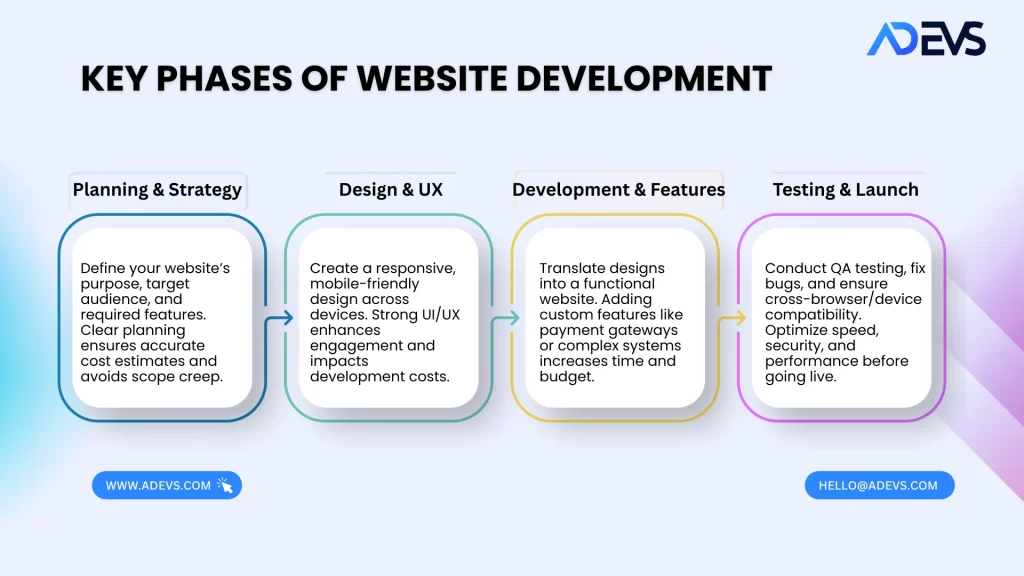
Before diving into the cost of website development, it’s important to understand the different stages involved in building a website. Each phase plays a critical role in determining the overall cost of the project.
Planning and Strategy
The foundation of any successful website development project begins with thorough planning. During this phase, you’ll define your website’s purpose, audience, and core functionalities. Whether you need an eCommerce website, a simple informational site, or a complex platform, the planning stage will have a significant impact on the final cost.
Design and User Experience (UX)
Website design, particularly responsive web design, is crucial in today’s market. Your website must be accessible and functional across all devices, including smartphones, tablets, and desktops. A mobile-friendly design not only enhances user experience but also improves your site’s ranking in search engine results. The cost of website design varies based on the complexity of the UI/UX design and whether you opt for a custom design or a pre-built template.
Development and Features
The development phase involves the technical implementation of your website. This is where the real complexity arises, as custom website development requires more time and effort. Adding features like payment gateways, custom software integrations, and advanced functionality can significantly impact the website development cost.
Testing and Launch
Before launching your website, rigorous testing is required to ensure everything works seamlessly across devices and browsers. This phase includes quality assurance (QA) testing, debugging, and ensuring your website is optimized for speed and security.
Website Design vs. Website Development Costs
Business owners often use the terms “design” and “development” interchangeably, but they represent two distinct parts of a project with separate costs. Understanding the difference helps you see where your budget is going.
Website Design Costs
This covers the visual and user experience (UX) aspects of your site. Designers craft the look and feel, including layout, color scheme, typography, and branding. Using a pre-made template is less expensive, but a custom design involves creating a unique UI and UX tailored to your brand and target audience.
Estimated Cost Impact: $2,000 to $15,000+
Tip:
- Template-based designs: lower cost, faster setup
- Custom designs: higher investment, stronger brand identity and usability
Website Development Costs
This is the technical side of building the website. Developers take design files and turn them into a functional, live site. This includes:
- Front-end development: what users see and interact with (buttons, forms, animations)
- Back-end development: the server, database, APIs, and application logic that power the site
The cost depends heavily on complexity. A basic site with static pages is far cheaper than a custom platform with e-commerce, portals, or third-party integrations.
Estimated Cost Impact: $5,000 to $50,000+ depending on features, integrations, and scalability needs.
Key Takeaway: Design creates the experience. Development makes it work. Both are essential, and cutting corners on either side can limit your website’s effectiveness.
Free Resources: For tips on improving your website’s performance, visit Google’s guide to website performance optimization
Factors That Affect Website Development Costs
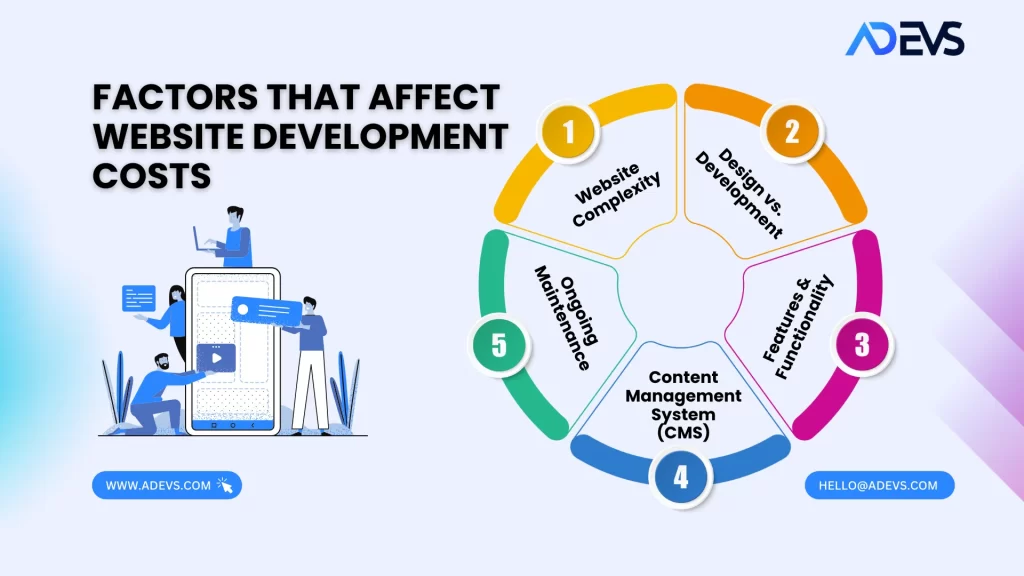
The final website development cost is a sum of many parts. Understanding these variables will help you see why a simple quote is often not so simple. The primary factors include the complexity of the design, the number and type of features, and the technology stack used. Here are the most significant elements that determine website development cost:
1. Website Complexity
The complexity of your website is a primary cost factor. A simple template-based website will be less expensive than a custom-built website. For small businesses looking for a basic informational site, template-based development offers an affordable website development option. However, for businesses that require custom features or advanced functionalities (like eCommerce platforms or customer portals), the cost will be significantly higher.
2. Design vs. Development
While design and development are two separate phases, they are closely intertwined. Custom web design often involves a higher upfront cost, but it allows for a unique user interface that aligns with your brand’s identity. On the other hand, using pre-built templates for design can reduce costs. The website development services cost will also vary based on the amount of coding required for custom functionalities.
3. Features and Functionality
The more features you add, the more the development will cost. Integrating payment systems, advanced search functions, CRM systems, and custom software will increase your website development cost. For SMBs looking for a cost-effective website solution, it’s important to prioritize essential features and scale over time.
4. Content Management System (CMS)
Choosing the right CMS can impact both the development cost and the ease of website maintenance. Popular platforms like WordPress, Shopify, and Wix offer affordable and scalable options, particularly for small businesses. A custom-built CMS can be more expensive but provides more flexibility and control over your site’s functionality.
5. Ongoing Maintenance and Updates
Website development doesn’t end at launch. Ongoing website maintenance cost is a critical factor to consider. Regular updates, security patches, and performance optimizations are essential to keep your site running smoothly. These costs should be factored into your long-term budget.
How Features Affect Your Website Development Budget
The functionality you include in your website is one of the biggest cost drivers. A simple brochure site will always cost less than a feature-rich platform with advanced tools.
CMS Website Development
A Content Management System (CMS) like WordPress, Webflow, Shopify, or a custom-built solution allows you to manage and update your site without a developer. While CMS setup adds to the initial cost, it reduces long-term expenses by giving you control over content updates.
Estimated Cost Impact: $2,000 – $15,000+ depending on CMS choice, customization, and required plugins.
E-commerce Website Development
If you plan to sell products online, you’ll need e-commerce functionality. This involves setting up product catalogs, shopping carts, secure payment gateways, and order management. Costs rise with added complexity such as variable pricing, subscriptions, multi-warehouse inventory, or ERP/CRM integrations.
Estimated Cost Impact: $5,000 – $50,000+ depending on platform (Shopify, Magento, custom build) and complexity.
Custom Feature Development
Any functionality that isn’t available through standard templates or plugins must be custom-built. Examples include interactive calculators, booking engines, membership portals, or third-party API integrations. Custom development is typically the most expensive component since it requires specialized coding and testing.
Estimated Cost Impact: $2,500 – $30,000+ depending on feature scope and integration complexity.
SEO Optimization Costs
While SEO is an ongoing marketing effort, the technical foundation should be built during development. This includes mobile responsiveness, optimized site speed, clean URL structures, and schema markup. Some agencies bundle this into development packages, while others charge separately.
Estimated Cost Impact (One-Time Technical SEO Setup): $1,000 – $5,000+
Pro Tip: Start with a CMS as the foundation, add e-commerce if you sell online, invest in custom features when needed, and never skip technical SEO. These choices directly shape your overall website development budget.
Average Website Development Costs
Now for the question on everyone’s mind: what are the actual numbers? The website development cost can be broken down into four general tiers based on complexity. Keep in mind that these are estimates, and prices can vary based on the agency, location, and specific project requirements.
Simple Websites (Using Templates or Basic Features)
A simple website is ideal for small businesses needing a professional online presence without complex functionality. These sites typically have 5–10 pages (e.g., Home, About, Services, Blog, Contact) and are often built using a pre-designed template on a platform like WordPress or Squarespace.
Estimated Cost: $3,000 – $10,000
What’s Included: Template-based design, basic features (like a contact form), mobile responsiveness, and a standard CMS setup. This is a cost-effective way to establish credibility online.
Best For: Businesses that need an informational “brochure” site to share services, location, and contact details.
Custom Websites (Tailored to Specific Business Needs)
A custom website is built from the ground up to meet unique business goals. It involves tailored design and development aligned with your brand, audience, and required functionality.
Estimated Cost: $10,000 – $40,000+
What’s Included: Unique UI/UX design, custom front-end and back-end development, and tailored integrations. The higher cost reflects the bespoke nature of the solution.
Best For: Growing businesses that need to stand out from competitors and require specific features beyond what templates can offer.
E-commerce Websites (Cost Breakdown for Online Stores)
E-commerce websites are more complex due to secure payment processing, inventory management, and customer account functionality. The price depends heavily on the scale of the store and required integrations.
Estimated Cost: $20,000 – $75,000+
What’s Included: Everything in a custom site, plus e-commerce platform setup (Shopify, Magento, or similar), payment gateway integration, product catalog templates, secure checkout, and order management. Costs rise for advanced features like subscriptions, multi-warehouse inventory, or ERP integrations.
Best For: Businesses selling products directly to consumers online and requiring a seamless shopping experience.
Enterprise Website Development (For Large-Scale Organizations)
Enterprise websites are built for corporations, government agencies, or global brands with advanced scalability, performance, and compliance needs. These projects often involve complex workflows and deep integration with internal systems.
Estimated Cost: $40,000 – $250,000+
What’s Included: Everything in a custom or e-commerce build, plus enterprise-grade architecture, multi-language/multi-region capabilities, advanced security, system integrations (ERP/CRM/HR), AI-driven personalization, and support for high traffic. Additional costs may apply for compliance with HIPAA, SOC2, or GDPR standards.
Best For: Enterprises, universities, government organizations, or global brands that require a secure, scalable, and feature-rich platform to support complex operations.
Ongoing Costs: Maintenance and Updates
Launching your website isn’t the end of the investment. Just like a physical store, a website requires regular upkeep to remain secure, fast, and relevant. Ongoing costs generally fall into two categories: technical maintenance and growth activities.
Technical Maintenance Costs
Hosting: $100 – $1,200 per year, depending on whether you choose shared, managed, or cloud hosting.
Domain Name: $15 – $60 per year for standard domains.
SSL Certificate: Often included with hosting or free via Let’s Encrypt. Premium SSLs (EV or Wildcard) can cost $50 – $300 per year.
Software Updates: Regular updates to your CMS, plugins, and themes are critical for security. If handled by an agency, this typically costs $50 – $500+ per month.
Growth & Marketing Costs
Content Updates & SEO: Fresh content and ongoing optimization are vital for traffic and rankings. Monthly retainers for content and SEO services typically range from $750 to $5,000+ depending on your industry and goals.
Pro Tip: Skipping website maintenance can lead to downtime, security breaches, and lost revenue. Budgeting for these ongoing costs is just as important as your initial website build.
How to Save on Website Development Costs
While a quality website is a worthwhile investment, there are ways to manage costs without sacrificing quality. Here are a few strategies for affordable website development.
Use Website Builders or Templates
For businesses with very limited budgets, DIY website builders like Squarespace or Wix can be a starting point. However, for a more professional and scalable solution, using a pre-designed template on a powerful platform like WordPress or Shopify is a better option. A professional developer can customize a template website to fit your brand, which is a cost-effective way to get a high-quality site for less than a fully custom build.
While using templates can be cost-effective, custom-built websites provide more control over design and functionality. Learn more about the differences between custom and off-the-shelf solutions
Prioritize Core Features and Scale Over Time
You don’t need to launch with every feature you can imagine. A common cost-effective website strategy is to build a Minimum Viable Product (MVP) that includes only the essential, prioritized core features. For example, launch with a simple contact form instead of a complex booking system. Once your website starts generating revenue or proving its value, you can reinvest in adding more advanced functionality. Building scalable websites from the start allows you to grow your digital presence in tandem with your business.
Investing in Your Digital Future
Understanding the website development cost is the first step toward making a smart, strategic investment in your business’s future. By breaking down the process into design, development, and ongoing maintenance, you can create a realistic budget and avoid unexpected expenses. Whether you choose an affordable website development solution with a template or invest in a fully custom build, the key is to align your budget with your business goals.For a small business, a well-built website is a powerful asset that works for you around the clock. By carefully planning and prioritizing, you can secure a cost-effective web solution that not only looks great but also delivers measurable results.